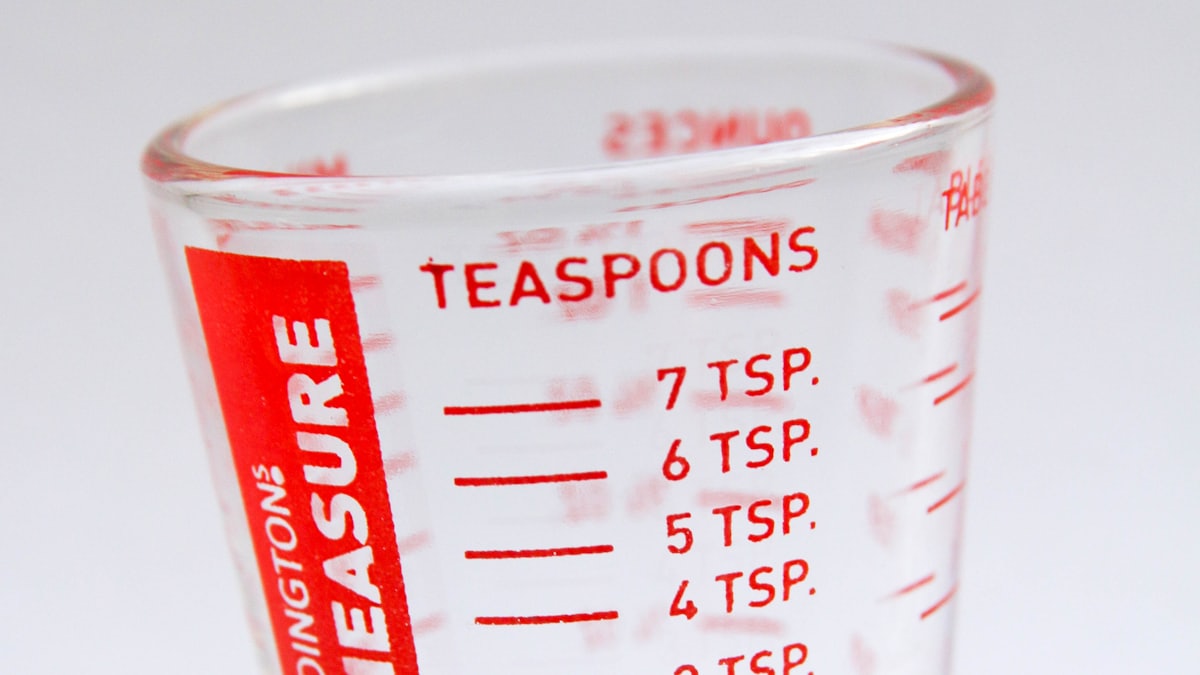
Reliable recipe costing depends on consistent units. Weigh in grams and measure liquids in millilitres rather than trusting cups, because a cup of flour and a cup of sugar weigh very differently — volume-to-weight conversion depends on the ingredient’s density. A professional kitchen standardises on metric weight, which makes scaling and costing exact and removes the single most common source of costing error.
Why units decide whether costing works
You buy ingredients by weight and volume — kilos, litres — but recipes are often written in cups, spoons and "handfuls." Every time those two worlds meet, there is a chance to get the maths wrong, and a wrong unit silently corrupts your plate cost. Costing 150 grams of an ingredient as 150 millilitres, or a "cup" as a fixed weight, is how a dish looks profitable on paper and is not in the till.
Weight beats volume, always
The key professional habit: weigh, don't measure by volume. A cup is a volume, and the same volume of different ingredients weighs wildly different amounts — a cup of flour is roughly 120g, a cup of sugar about 200g, a cup of water 240g. Volume-to-weight conversion is not a single number; it depends on the ingredient's density. Weighing in grams removes the guesswork, which is why every serious kitchen and every accurate cost sheet works in metric weight.
Liquids, pieces and the sensible exceptions
Liquids are the fair exception — millilitres are practical and, for water-like liquids, close enough to grams to cost cleanly. "Per piece" ingredients (eggs, lemons, buns) are best costed per unit at their real purchase price. The rule of thumb: solids by weight, liquids by volume, countables by piece — and convert everything to those bases before it reaches your recipe card or cost sheet.
Clean units make scaling painless
Consistent units are also what make scaling a recipe reliable. When a recipe is written in grams and millilitres, multiplying by a scaling factor is exact; when it is written in cups and pinches, scaling compounds every rounding error. Standardise the units once, and both your costing and your batch production get more accurate for free.
Recipe Unit Converter
Convert recipe units both ways: cups, tablespoons, ounces, pounds to grams and millilitres, plus Indian units like katori and tola, with ingredient-correct densities.
Step by step
Standardise a recipe’s units for accurate costing.
- Convert solids to grams. Weigh, or use ingredient-specific density to convert cups to grams — never a single blanket figure.
- Convert liquids to millilitres. Measure liquids by volume; for water-like liquids, millilitres and grams are close enough to cost cleanly.
- Cost countables per piece. Price eggs, lemons, buns and similar at their real per-unit purchase cost.
- Rewrite the recipe card in these units. Lock the standardised units into the card so costing and scaling stay exact.
Frequently asked questions
Can I convert cups to grams with one number?
No. Volume-to-weight conversion depends on the ingredient’s density. A cup of flour is about 120g, a cup of sugar about 200g, and a cup of water about 240g, so there is no single cups-to-grams factor — weigh instead.
Why do professional kitchens weigh instead of using cups?
Because weight is exact and volume is not. The same cup measure weighs different amounts for different ingredients, which introduces error into both cooking and costing. Weighing in grams removes that error and makes recipes repeatable and cheap to cost.
Should liquids be measured by weight or volume?
Volume (millilitres) is practical for liquids, and for water-like liquids millilitres are close enough to grams to cost cleanly. Solids should be weighed in grams and countable items priced per piece.
Keep reading
How to Cost a Recipe and Price a Plate: The Indian Restaurant Guide
A step-by-step guide to costing any recipe ingredient-by-ingredient, finding your true cost per portion, and setting a menu price at the food-cost % you actually want.
How to Scale a Recipe Up or Down Without Wrecking the Taste
Scaling a recipe is not just multiplying everything. Learn the scaling-factor method, what scales linearly and what does not, and how to keep taste and cost intact.